Traditional vs Peel and Stick Wallpaper: Which Should You Choose?
Peel and stick wallpaper or traditional paste the wall? Compare installation, finish, longevity and removal.

Words by
Creative Brand Manager
I’m a creative Brand Manager with a strong foundation in designing and marketing beautiful products for the home. With a background rooted in design, I’ve spent much of my career exploring how aesthetics and functionality come together to shape the way we live. I’m deeply passionate about the evolution of interior trends, how they emerge, how they influence our spaces, and ultimately how products find their place within the home. For me, it’s not just about creating something visually appealing; it’s about understanding how people use, experience, and connect with the pieces around them every day. Through my work, I aim to bridge the gap between design and real-life living, bringing thoughtful, trend-aware products to life while telling the stories behind them.
Peel and stick wallpaper is a self-adhesive paper designed for quick application and easy removal, which makes it a good fit for short-term schemes and rented homes. Traditional paste-the-wall wallpaper, like the Martha Stewart collection at No Two Houses, takes more preparation but rewards you with a wider choice of designs, tighter seams and a finish built to stay.
What is the difference between peel and stick and traditional wallpaper?
The difference comes down to how the paper attaches to your wall. Peel and stick wallpaper has a pressure-sensitive adhesive already on the back, protected by a liner. You peel the liner away, press the paper to the wall and smooth it down, with no paste, no bucket and very little drying time. Traditional wallpaper arrives with a plain back and relies on wallpaper paste to bond it to the wall. Within that traditional category, paste-the-wall papers are the modern standard: the paste goes directly onto the wall, the dry paper goes on top, and there is no soaking or pasting table involved. Every design in the Martha Stewart collection at No Two Houses is a non-woven, paste-the-wall paper on a 52 cm × 10 m roll (about 20.5 in × 32.8 ft), and our guide to what paste the wall wallpaper is explains why that matters for first-time hangers.
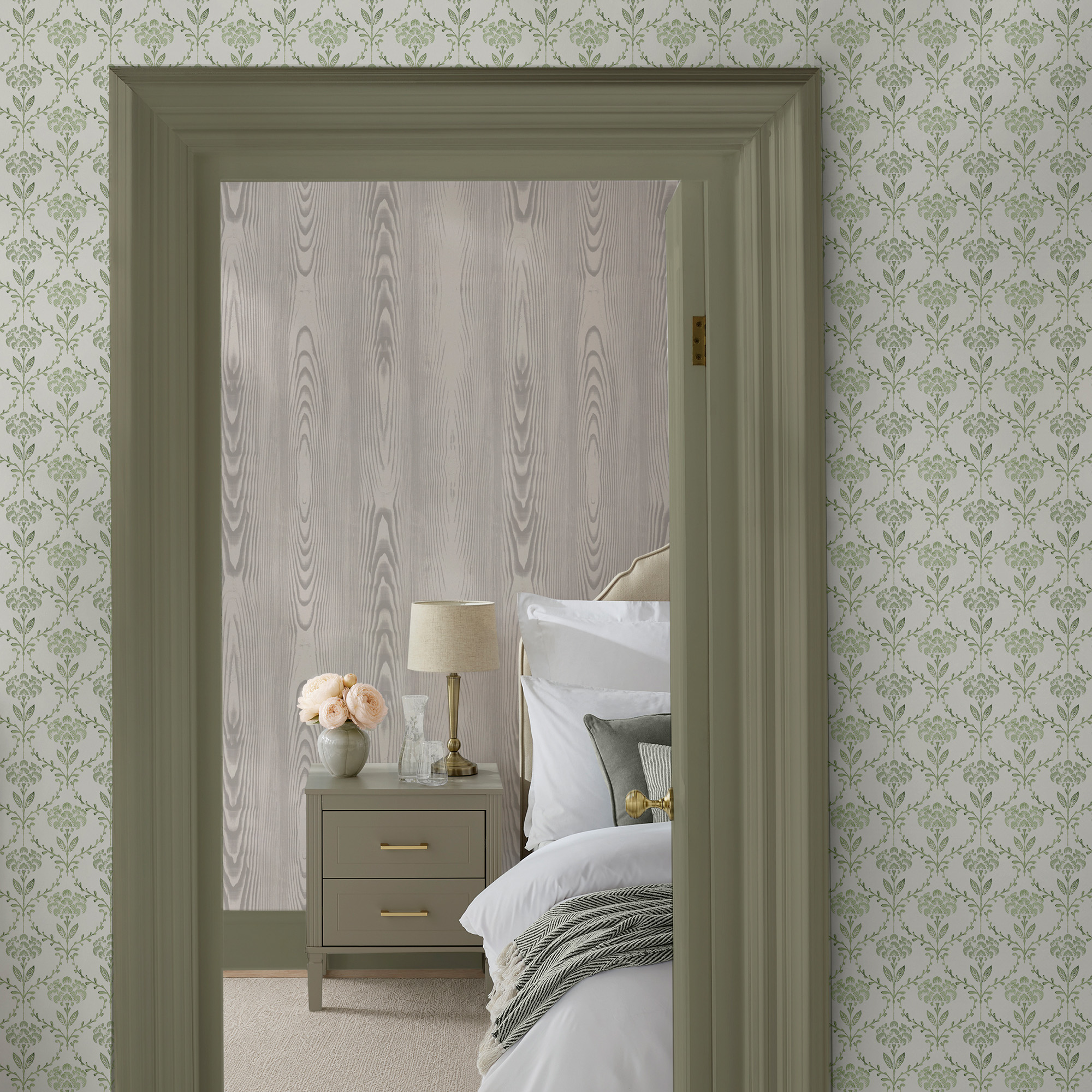
Peel and stick vs traditional wallpaper: how do they compare?
The honest answer is that each does something well. The table below sets the two side by side on the factors that tend to decide the purchase. It is written for a typical peel and stick vinyl and a typical non-woven paste-the-wall paper; individual products vary, so always check the label of the paper in your hands.
Factor | Peel and stick wallpaper | Traditional paste-the-wall wallpaper |
Installation | No paste. Peel the liner, position and smooth. Forgiving for a first attempt on a small wall; repositionable while the adhesive is fresh. | Paste applied to the wall with a roller, dry paper hung on top. More set-up, but the paper slides into place and the paste gives you working time to align the pattern. |
Finish and seams | Edges are butted by hand with no paste to help them settle, so seams can show, and corners or edges may lift in warm, humid rooms. | Pasted seams bed down flat as they dry. Non-woven papers are dimensionally stable, so they do not expand or shrink on the wall and joins stay tight. |
Longevity | Designed to be temporary. Adhesion weakens over time, especially near heat, sun and steam. | Designed to stay. A well-hung non-woven paper keeps its grip and its color for years. |
Pattern choice | A growing but smaller range, often weighted to simple geometrics and small-scale prints. | The full breadth of wallpaper design, from fine stripes to large-scale florals and damasks. The Martha Stewart collection alone offers 41 designs. |
Surface requirements | Needs a smooth, clean, fully cured painted surface. Texture, matte or chalky paint and fresh plaster all reduce adhesion. | Tolerates minor imperfections once the wall is sound, sized and lined where needed. Paste bonds to a wider range of surfaces. |
Removal | Peels away by hand, usually in full strips. Can pull paint on some finishes. | Many non-woven papers strip dry; others need scoring and steam. More effort, but a predictable process. See our how to remove wallpaper guide. |
Cost in general terms | Often lower per roll and no paste to buy, but shorter life means it may be replaced sooner. | Roll price plus paste and basic tools. A longer life spreads that cost over more years on the wall. See current pricing on each product page. |
Is peel and stick wallpaper worth it?
For the right job, yes. Peel and stick wallpaper earns its place when the room, or your tenancy, has a short horizon. It lets you test a bold color in a powder room before committing, line the back of a bookcase, refresh a nursery you know will change in two years, or add pattern to a home you do not own. It also removes the fear factor for anyone who has never hung paper. No Two Houses also sells a small range of peel-and-stick designs, which you can find among all our wallpaper.
Where it struggles is permanence and precision. Self-adhesive vinyl relies entirely on the wall surface beneath it, so any texture, dust or chalky paint shows up later as lifting corners. Large pattern repeats are harder to align without paste to slide the paper, and a long hallway or stairwell quickly exposes seams. If you want a room that still looks finished in five years, the pasted route is the better investment.
Who should choose peel and stick wallpaper?
Peel and stick is the right call when flexibility matters more than longevity. Choose it if any of these describe you:
- You rent, and your lease requires walls returned to their original state. Our dedicated guide to wallpaper for renters goes deeper on this.
- You are decorating a space that will change soon, such as a nursery, a dorm room or a seasonal display.
- The surface is small, smooth and recently painted in a satin or eggshell finish.
- You want to trial a pattern or color on one wall before committing to a full room.
- You would rather spend an afternoon than a weekend, and you are happy to accept visible seams in exchange.
Who should choose traditional paste-the-wall wallpaper?
Paste-the-wall is the right call when you are decorating a home you intend to live in and love for a long time. Choose it if:
- You want a specific design. The Martha Stewart collection spans tailored stripes, archival florals, damasks and wood effects that have no self-adhesive equivalent.
- The room is a hallway, living room, dining room or bedroom where seams and lifting edges would be noticed every day.
- Your walls are older, slightly uneven or painted in a matte finish that self-adhesive vinyl would not hold on to.
- You care about the finish: pasted non-woven paper dries flat, with joins that disappear into the pattern.
- You are happy to prepare properly once and not think about the walls again for years.
How do you hang paste-the-wall wallpaper?
Paste-the-wall is closer to peel and stick in effort than most people expect, because the paper itself stays dry and manageable. Here is the process in brief; our full how to hang wallpaper guide and the downloadable How to Hang Wallpaper guide (PDF) cover every step in detail.
- Prepare the wall. Fill holes, sand smooth, wipe down and let it dry. Size a bare or newly plastered wall so the paste does not soak in.
- Mark a plumb line. Use a level to draw a true vertical about one roll width (roughly 20 in, or 52 cm) from your starting corner, since corners are rarely straight.
- Choose and mix the right paste. A paste formulated for non-woven paste-the-wall papers is essential; our wallpaper paste guide explains which to pick.
- Paste the wall. Roll an even coat slightly wider than one drop, working from the plumb line outward.
- Hang the first drop. Offer the dry paper up to the plumb line, leaving an overlap of around 2 in (5 cm) at the ceiling, and smooth from the center outward with a soft brush or smoother.
- Match and butt the next drop. Check the match type on the label. Martha Stewart Classic Stripe and Garden Stripe are straight match; Floral Vine is an offset match; Wood Panel is a free match, so it needs no aligning at all.
- Trim and wipe. Crease the excess at ceiling and baseboard, trim with a sharp blade, and sponge away any paste on the surface while it is wet. Every Martha Stewart paper is spongeable, so this is a gentle wipe rather than a scrub.
Which Martha Stewart designs make the strongest case for going traditional?
A few designs show exactly what pasted paper can do that self-adhesive cannot. Martha Stewart Classic Stripe Georgica Beach is a broad, smart stripe that accentuates the height of a room, and a long run of stripes only works when every seam lies flat and true. Martha Stewart Floral Vine Porcelain Blue is an offset-match design with twisting vines, blooms and birds; the paste gives you the working time to line the vines up drop after drop. Martha Stewart Florentine Tarn brings archival damask depth to a dining room, where the pattern deserves to stay for years. And Martha Stewart Bedford Faux Bois Goose Down gives the soft, grained look of wood panels in a smooth printed finish, with a 64 cm straight repeat that is easy to hang. If you are also weighing our other heritage collections, our comparison of Martha Stewart, William Morris and Laura Ashley wallpaper sets them side by side.
Frequently asked questions about peel and stick vs traditional wallpaper
Can you put peel and stick wallpaper over textured walls?
It is not recommended. Self-adhesive vinyl needs a smooth, flat surface to bond across its whole back, and texture leaves air pockets that cause edges to lift. Skim-coating or lining the wall first solves the problem, at which point a pasted paper becomes just as easy to hang.
Does peel and stick wallpaper damage paint?
It can. On fresh, matte or poorly adhered paint, the adhesive may pull the paint layer away on removal. Test a small, hidden area first, and allow new paint to cure fully before applying any self-adhesive paper.
Is paste the wall wallpaper hard to remove?
No. Many non-woven paste-the-wall papers can be stripped dry from a sound wall, and stubborn areas respond to scoring and a steamer. Our how to remove wallpaper guide walks through both methods.
Is the Martha Stewart wallpaper collection available as peel and stick?
No. Every one of the 41 Martha Stewart designs at No Two Houses is a non-woven, paste-the-wall wallpaper. It is not self-adhesive and is not sold as a removable or temporary product.
Which wallpaper is best for renters?
Peel and stick is usually the safer choice where the lease requires walls returned to their original condition, provided the paint beneath is sound. For a fuller answer, including how to check with your landlord and prepare the surface, read our guide to wallpaper for renters.
Order samples and decide in your own light
The best way to settle the peel and stick vs traditional question is to hold a sample against your wall. Every design in the Martha Stewart collection has an Order sample option, so you can see the color, the finish and the quality of the non-woven paper before committing to a room. Our guide to how to use wallpaper samples shows how to test them properly, and when you are ready to hang, the paste-the-wall steps above will have you finished sooner than you think.
