How Much Wallpaper Do I Need? Easy Guide
Learn how much wallpaper you need: a simple measuring method, a worked example, and pattern repeats for every Martha Stewart design. Order a sample to start.

Words by
Creative Brand Manager
I’m a creative Brand Manager with a strong foundation in designing and marketing beautiful products for the home. With a background rooted in design, I’ve spent much of my career exploring how aesthetics and functionality come together to shape the way we live. I’m deeply passionate about the evolution of interior trends, how they emerge, how they influence our spaces, and ultimately how products find their place within the home. For me, it’s not just about creating something visually appealing; it’s about understanding how people use, experience, and connect with the pieces around them every day. Through my work, I aim to bridge the gap between design and real-life living, bringing thoughtful, trend-aware products to life while telling the stories behind them.
To work out how much wallpaper you need, divide the room perimeter in inches by the roll width to get the number of drops, add the pattern repeat to the wall height to get the drop length, and divide the roll length by that to find drops per roll. Divide drops by drops per roll, round up, and add one spare.
Every Martha Stewart wallpaper at No Two Houses is sold in the same roll size, 52 cm × 10 m (about 20.5 in × 32.8 ft), so once you have learned the method for one design you can use it for all 41. The only number that changes between patterns is the repeat, and this guide gives you every one of them.
What do I need to measure for wallpaper?
Before any arithmetic, you need three measurements and two facts from the product page. Measuring takes ten minutes with a steel tape, and it is worth doing twice; walls in older houses are rarely perfectly square, so always record the tallest height you find rather than an average.
- Wall width of every wall you plan to paper, measured along the baseboard in inches.
- Wall height from the top of the baseboard to the ceiling (or to the chair rail or picture rail, if you are papering below or above one), measured at the tallest point.
- Door and window openings, noted but, for now, not subtracted. More on that below.
- Roll size from the product page. For Martha Stewart designs this is always 52 cm × 10 m (20.5 in × 32.8 ft).
- Pattern repeat and match type, also on the product page. This is the figure most people miss, and the one that most often leaves a project a roll short.
How do I calculate how much wallpaper I need?
Here is the full method, written for a US reader working in feet and inches. Convert everything to inches first so you are only dividing like by like. The arithmetic is simple enough to do on your phone, and each step is checkable against the worked example that follows.
- Add up the wall widths to get the perimeter of the room in inches. Include the walls behind doors and windows for now.
- Divide the perimeter by the roll width (20.5 in for every Martha Stewart design). Round up to a whole number. This is how many drops, or vertical strips, you will hang.
- Add the pattern repeat to your wall height to get the length of one drop. This allowance lets you line the pattern up from one strip to the next and gives you trimming room at the top and bottom.
- Divide the roll length (32.8 ft, or 394 in) by the drop length. Round down this time; a roll that gives 3.2 drops gives you three usable drops, not four.
- Divide total drops by drops per roll and round up. That is your base number of rolls.
- Add one spare roll from the same batch. You will not regret it.
If you would rather skip the long division, No Two Houses is developing a wallpaper calculator that runs these exact steps for you. Until it goes live, this guide is the calculator, and the method below will give you the same answer.
A worked example: a 10 ft × 12 ft room with 8 ft ceilings
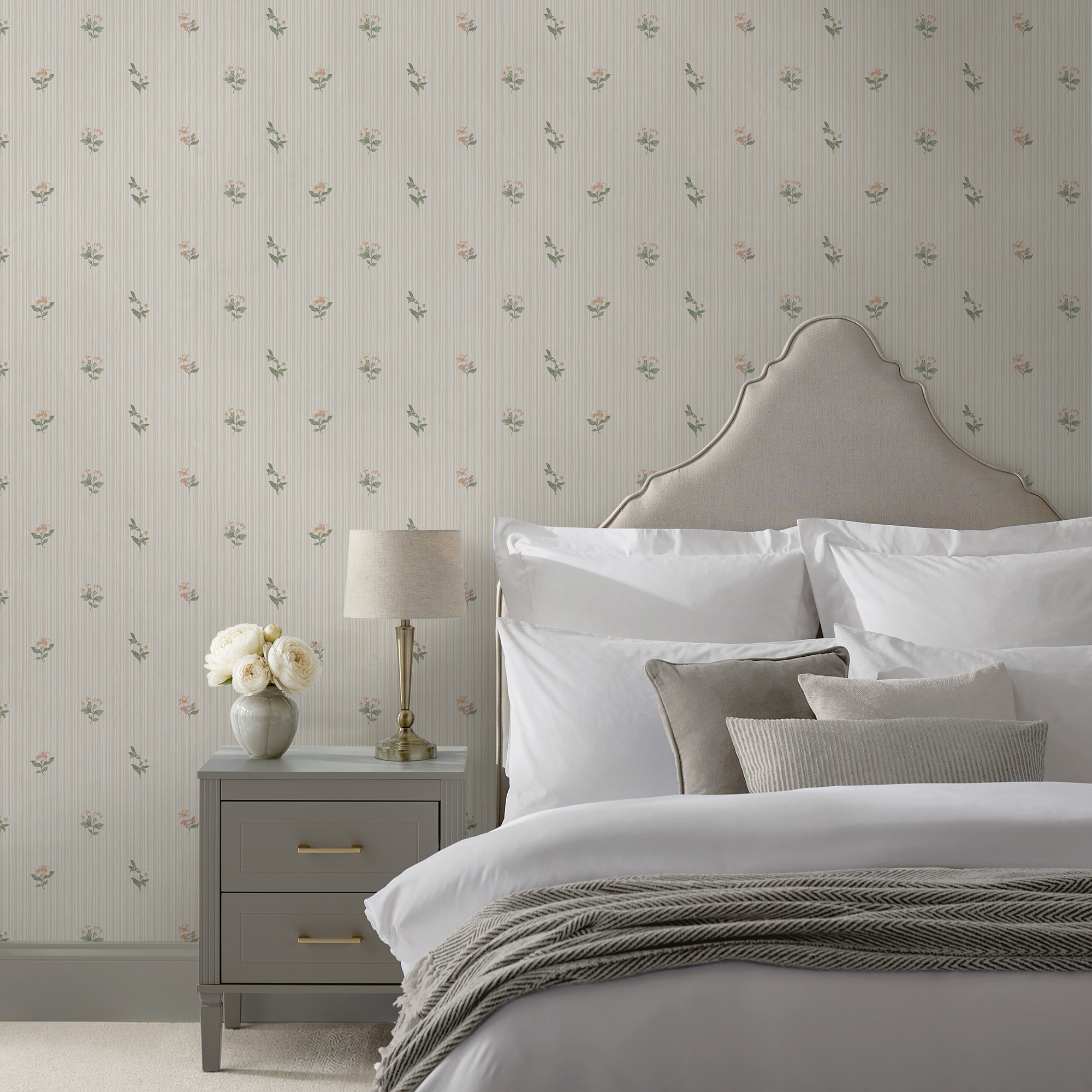
Picture a guest bedroom, 10 ft by 12 ft (about 3 m × 3.7 m) with 8 ft (2.4 m) ceilings, papered on all four walls in Martha Stewart Garden Stripe Linen, which has a 64 cm (about 25 in) straight-match repeat. Here is how the numbers run.
- Perimeter: 10 + 12 + 10 + 12 = 44 ft. In inches, 44 × 12 = 528 in.
- Drops: 528 ÷ 20.5 = 25.8. Round up to 26 drops.
- Drop length: 96 in wall height + 25 in repeat = 121 in, or just over 10 ft (10.1 ft).
- Drops per roll: 32.8 ft ÷ 10.1 ft = 3.2. Round down to 3 drops per roll.
- Rolls: 26 ÷ 3 = 8.7. Round up to 9 rolls.
- Spare: add one, for a total order of 10 rolls.
Notice that step four is where the repeat earns its keep. Without the 25 in allowance, the drop would be 8 ft and you would get four drops per roll and a false answer of seven rolls. Every design in the collection carries a repeat, so this step is never optional, even for a stripe.
What is a pattern repeat, and why does it change the answer?
The pattern repeat is the vertical distance before a design repeats itself along the roll. When you hang the second strip beside the first, the motifs have to line up across the seam, so you may need to slide the new strip up or down by anything up to a full repeat before you cut. That sliding is paper you cannot use elsewhere, which is why it is added to every drop rather than once per roll.
The match type tells you how the strips line up, and it matters as much as the repeat length.
Match type | How the pattern lines up | Allowance to add per drop | Martha Stewart designs |
Straight match | The same motif sits at the same height on every strip | One full repeat (safe) | Classic Stripe, Garden Stripe, Heritage Garden Stripe, Artisan Floral, Florentine, Chateau Fleur, Jacobean, Bedford Faux Bois |
Offset (half-drop) match | Each strip is shifted by half a repeat against the one before, so the motif staggers across the wall | One full repeat, and consider an extra roll on large walls | Floral Vine |
Free match | No alignment needed between strips | Trimming allowance only, around 4 in (10 cm) | Wood Panel |
A straight match is the most forgiving of the patterned options. An offset match looks wonderfully fluid on the wall, which is exactly what gives Floral Vine its rhythmic, trailing quality, but it can generate more offcuts because alternate strips start at different points in the repeat. A free match, like the planked Wood Panel, is the most economical of all, because you can cut strips one after another with almost no waste
What are the pattern repeats of the Martha Stewart wallpaper collection?
Here is every design family in the Martha Stewart wallpaper collection with its repeat and match. Because every roll in the collection measures 52 cm × 10 m, this table plus the method above is a complete wallpaper calculator with repeat for all 41 colorways. The drops-per-roll column assumes an 8 ft (96 in) wall; for taller ceilings, rerun step three with your own height.
Design | Repeat | Match | Drop length for 8 ft wall | Drops per roll (8 ft wall) |
Classic Stripe | 53 cm (20.9 in) | Straight | 117 in (9.8 ft) | 3 |
Garden Stripe | 64 cm (25.2 in) | Straight | 121 in (10.1 ft) | 3 |
Heritage Garden Stripe | 48 cm (18.9 in) | Straight | 115 in (9.6 ft) | 3 |
Floral Vine | 70 cm (27.6 in) | Offset | 124 in (10.3 ft) | 3 |
Artisan Floral | 64 cm (25.2 in) | Straight | 121 in (10.1 ft) | 3 |
Florentine | 64 cm (25.2 in) | Straight | 121 in (10.1 ft) | 3 |
Chateau Fleur | 52 cm (20.5 in) | Straight | 117 in (9.7 ft) | 3 |
Jacobean | 84 cm (33.1 in) | Straight | 129 in (10.8 ft) | 3 |
Wood Panel | 75 cm (29.5 in) | Free | 100 in (8.3 ft) with 4 in trim allowance | 3 |
Bedford Faux Bois | 64 cm (25.2 in) | Straight | 121 in (10.1 ft) | 3 |
Two things stand out. First, on a standard 8 ft wall, every design gives three drops per roll, so for most rooms the roll count depends on your perimeter rather than your pattern choice. Second, the larger the repeat, the less margin you have: Jacobean, at 84 cm, uses 10.8 ft of a 32.8 ft roll per drop and leaves very little spare, so a 9 ft ceiling tips it to two drops per roll. Always check this before committing to a tall room.
Should I subtract doors and windows when calculating wallpaper?
In most rooms, no. It feels wasteful to buy paper for a wall that is half window, but the paper above and below an opening still has to be cut from a full-length drop so the pattern lines up with the strips either side. The piece you remove for the window is usually too short to use as a drop anywhere else. Treating openings as solid wall builds in exactly the margin a patterned paper needs.
There are two sensible exceptions. If a single opening is very large, such as a wall of glass doors that takes up most of one side of the room, you can leave that wall out of the perimeter and simply measure the strips beside it. And with a free-match design like Martha Stewart Wood Panel Natural, where offcuts can be used above doors without matching, you may deduct openings with more confidence. When in doubt, do not deduct; a spare roll costs far less than a stalled project.
Why order a spare roll and check batch numbers?
Wallpaper is printed in batches, and the color can shift very slightly from one batch to the next. On the roll the difference is invisible; on the wall, under daylight, two batches side by side can show as a faint stripe at the seam. Every roll carries a batch number on its label, so make it a habit to check that all the rolls in your delivery match before you open them, and set the labels aside until the room is finished.
The spare roll protects you in three ways:
- It covers the inevitable miscut, torn edge, or strip hung slightly out of plumb.
- It gives you a repair piece years later, when a scuff or a moved picture hook leaves a mark, and the design or batch may no longer be available.
- It lets you finish from the same batch rather than ordering a single roll later and hoping for a match.
Order it with your main order so it comes from the same print run, and store it flat, in its wrapper, somewhere dry.
How do I measure for wallpaper on a feature wall or a hallway?
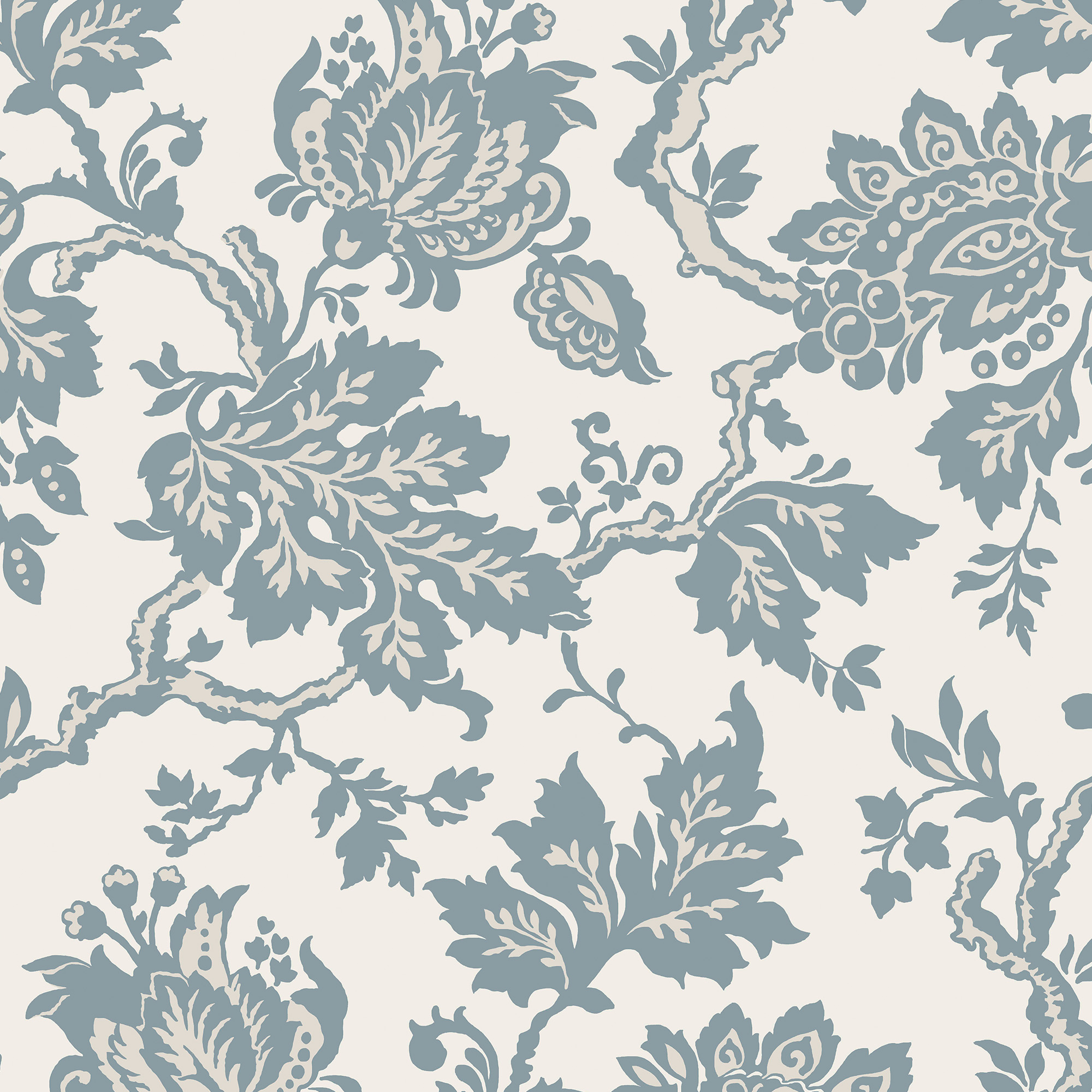
The method does not change, only the shape you are measuring. For a feature wall, your perimeter is simply that one wall's width. A 14 ft (4.3 m) wall at 8 ft high in Martha Stewart Floral Vine Porcelain Blue works out as 168 in ÷ 20.5 = 8.2, so nine drops; at three drops per roll that is three rolls plus a spare. If you are still deciding which wall deserves the pattern, our guide to choosing a feature wall walks through the options.
Hallways and stairwells need two extra checks. Measure the height at the tallest point of a stairwell, because that single long drop sets the drop length for the whole run, and remember that drops above a door frame still count as full drops in a straight-match design. For a bathroom or kitchen, measure only the areas you intend to paper and leave tiled zones out entirely. In all cases, Martha Stewart papers are non-woven and paste-the-wall, so you hang them straight from the roll; our explainer on paste-the-wall wallpaper covers what that means for the job.
What else should I check before I order?
Once the roll count is settled, a few small steps will make sure the paper you order is the paper you want on the wall.
- Order a sample first. Colors read differently in your light than on a screen, and a sample also shows you the repeat at full scale.
- Confirm the repeat and match on the product page rather than from memory, especially if you are choosing between two designs in the same family.
- Buy your paste at the same time. Non-woven paste-the-wall papers need a paste formulated for them; our wallpaper paste guide covers what to look for.
- Read the hanging guide before delivery day. The How to Hang Wallpaper guide is a free download, and our step-by-step hanging article is worth a read with a cup of coffee the night before.
Frequently asked questions about calculating wallpaper
How many rolls of wallpaper do I need for a 12 × 12 room?
For a 12 ft × 12 ft room with 8 ft ceilings and a 64 cm (25 in) straight-match repeat, the perimeter is 576 in, which gives 29 drops at three drops per roll, so ten rolls plus one spare. Rerun the steps for your own height and repeat.
Does a bigger pattern repeat mean I need more wallpaper?
Usually, yes. A larger repeat adds more to each drop, which can tip a roll from three usable drops to two on taller walls, so you need more rolls to hang the same perimeter.
Should I add extra for a staircase or high ceiling?
Yes. Measure the tallest drop in the space and use that height in step three for every drop, then round down the drops per roll as usual. Tall rooms are where a spare roll matters most.
Can I use the same calculation for every Martha Stewart wallpaper?
Yes. Every design in the collection is a 52 cm × 10 m roll, so only the repeat and match type change. Use the table above for the repeat and the method will give you a reliable answer for any colorway.
What if my walls are not all the same height?
Use the tallest measurement for the whole room. Trimming a little extra from a shorter wall is easy; a drop that comes up short cannot be fixed.
Ready to measure up? Start with a sample
Measuring a room properly is the quiet, satisfying part of a wallpaper project, and once the numbers are on paper the rest follows. Every design in the Martha Stewart collection at No Two Houses can be ordered as a sample, so pin one to the wall, live with it in morning and evening light, then come back to this page with your perimeter, your height and your chosen repeat. Ten minutes with a tape measure and you will know exactly how many rolls to order, with a spare tucked away for good measure.
